

How Are Dao Dto And Service Supposed To Interact
What is a DTO?
DTO, which stands for Data Transfer Object, is a design design conceived to reduce the number of calls when working with remote interfaces. As Martin Fowler defines in his web log, the master reason for using a Data Transfer Object is to batch up what would exist multiple remote calls into a single one.
For instance, lets say that nosotros were communicating with a RESTful API that exposes our cyberbanking account data. In this situation, instead of issuing multiple requests to check the electric current status and latest transactions of our account, the depository financial institution could expose an endpoint that returned a DTO summarizing everything. As one of the most expensive operations in remote applications is the round-trip time between the client and the server, this coarse-grained interface can help improving operation by a keen deal.
DTOs and Spring Kicking APIs
Another advantage of using DTOs on RESTful APIs written in Java (and on Leap Boot), is that they tin assistance hiding implementation details of domain objects (aka. entities). Exposing entities through endpoints tin can become a security consequence if nosotros do non carefully handle what properties can be changed through what operations.
As an example, allow's imagine a Coffee API that exposes user details and accepts user updates through ii endpoints. The first endpoint would handle Become requests and return user data, and the second endpoint would take PUT requests to update these details. If this application didn't have advantage of DTOs, all the backdrop of the user would be exposed in the first endpoint (e.1000. password) and the second endpoint would have to be very selective on what properties would accept when updating a user (e.g. not everybody can update the roles of a user). To overcome this situation, DTOs can come up in handy by exposing just what the get-go endpoint is intended to expose, and by helping the 2nd endpoint to restrict what it accepts. This feature helps united states of america to keep the integrity of the data in our applications.
"DTOs can aid usa to keep the integrity of data on Java applications."

Tweet This
Throughout this article, nosotros will take advantage of DTOs to help us handle situations like that. As we will see, this design blueprint will introduce a few more classes to our awarding, just will better its security.
ModelMapper Introduction
To avert having to write cumbersome/boilerplate code to map DTOs into entities and vice-versa, we are going to use a library called ModelMapper. The goal of ModelMapper is to make object mapping easy by automatically determining how one object model maps to another. This library is quite powerful and accepts a whole agglomeration of configurations to streamline the mapping process, but it also favors convention over configuration past providing a default behavior that fits most cases.
The user manual of this library is well written and can exist a valuable resource if time comes where we demand to tweak the mapping process. To give a little taste of what this library can do, let's say that we had a User like that:
// assume getters and setters class User { long id; Cord firstName; String lastName; String e-mail; String password; String securitySocialNumber; boolean isAdmin; } And wanted to expose just the id, firstName, and electronic mail. By using ModelMapper we would have to create a DTO like this:
// presume getters and setters grade UserDTO { long id; String firstName; Cord email; } And then telephone call ModelMapper as follows:
ModelMapper modelMapper = new ModelMapper ( ) ; // user hither is a prepopulated User instance UserDTO userDTO = modelMapper. map (user, UserDTO . class ) ; That is, just past defining the structure that we want to betrayal and by calling modelMapper.map, nosotros achieve our goal and hibernate what is not meant to exist exposed. One might argue that libraries like Jackson provide annotations to ignore some properties when serializing objects, merely this solution restrict developers to a single way to express their entities. By using DTOs and ModelMapper, we can provide as many dissimilar versions (with dissimilar structures) of our entities as we desire.
What Will We Build?
From now on, we are going to focus on using DTOs to expose entities of a Spring Boot RESTful API. We are going to utilise ModelMapper to map from the entities that etch this API to DTOs, and vice-versa. As nosotros don't want to spend besides much time setting up a new project from the ground, nosotros are going to take advantage of the QuestionMarks project that we stated building in the previous article. There is no need to read the total commodity, we will clone the GitHub repository that supports the project, and we are going to checkout a specific Git tag that will give us a solid footing to focus on what we are interested on.
The idea behind QuestionMarks is that this application will enable users to practice and enhance their knowledge past answering a ready of multiple option questions. To provide a better organisation, these questions volition be grouped in different exams. For example, there could be an exam chosen JavaScript Interview that would hold a set of JavaScript related questions to help users to ready for interviews. Of course, in this commodity we won't build the whole application as it would take a lot of fourth dimension and would brand the article huge, but we will be able to encounter the technologies same in activity.
Throughout the previous article, we have integrated Leap Data JPA, PostgreSQL, and Liquibase to manage the persistence layer. We didn't created whatsoever RESTful endpoint before, as there was no proficient fashion of exposing entities. That is the master goal of this article.
Launching PostgreSQL
Before cloning the existing project, we need to setup a PostgreSQL case to support our database operations and persistence. Equally stated in the previous article, Docker can exist a dandy solution to launch applications without installing them on our development car.
Nosotros practise need Docker installed, but the process of installing it is quite elementary (for MacOS bank check this link, for Windows this link, and for Ubuntu this link). Having Docker properly installed, we tin run a dockerized case of PostgreSQL as follows:
docker run --name questionmarks-psql \ -p 5432:5432 \ -e POSTGRES_DB =questionmarks \ -e POSTGRES_PASSWORD =mysecretpassword \ -d postgres Note that if we practice not want to launch PostgreSQL inside a Docker case, or if nosotros practise take another PostgreSQL instance already available, we volition demand to guarantee that we have a database called questionmarks on it, and that the postgres user has mysecretpassword equally countersign. Or, we can modify these values in the . /src/master/resources/application.properties file:
jump.datasource.url = jdbc:postgresql://localhost/questionmarks spring.datasource.username = postgres bound.datasource.password = mysecretpassword spring.datasource.driver-class-name = org.postgresql.Driver Cloning QuestionMarks
Side by side step is to clone the GitHub repository that supports QuestionMarks, and checkout the specific tag for this article. We achieve that past issuing the following commands:
git clone https://github.com/auth0-weblog/questionmarks-server.git cd questionmarks-server git checkout post-2 Since we haven't created whatever endpoints in the previous article, there wouldn't be a good reason to run the awarding at present. Running it would do no harm, and Liquibase would create the tables structures to back up the v entities already created. Only waiting to run it afterwards developing our endpoints will produce the same upshot.
Later that we simply need to import the Spring Boot project in our preferred IDE (Integrated Evolution Environs).
Adding Dependencies
Having the QuestionMarks project cloned and imported on our IDE, we tin start evolving it to handle automated mapping of DTOs. The showtime step we need to take is to add ModelMapper equally a dependency in our . /build.gradle file. Nosotros will likewise add a dependency to hibernate-java8 library. We will need this artifact to be able to map Java8-specific classes to columns on our database.
// ... other definitions dependencies { // ... other dependencies compile ( 'org.modelmapper:modelmapper:1.1.0' ) compile ( 'org.hibernate:hibernate-java8:v.ane.0.Final' ) } Refactoring the Exam Entity
To witness the existent advantage of using DTOs, and to accept a more than meaningful case of the mapping procedure in action, we are going to refactor the Exam entity a fiddling bit. Nosotros are going to add together two engagement properties on information technology to keep rails of when the test was created and when it was final edited, and we are going to add a flag that indicates if it'southward published (available to the open public) or not. Allow'south open the . /src/master/java/com/questionmarks/model/Exam.java file and add together the following lines of code:
// ... other imports import java.time. LocalDateTime ; // ... annotations public class Exam { // ... other properties @NotNull individual LocalDateTime createdAt; @NotNull private LocalDateTime editedAt; @NotNull private boolean published; } Note that without the hibernate-java8 library imported in the final section, JPA/Hibernate wouldn't exist able to automatically map LocalDateTime to the database. Fortunately this library exists to aid us, otherwise we would need to create our own converters.
We also have to add together the new backdrop (as columns) to the PostgreSQL database that supports our application. Since in the concluding commodity nosotros set Liquibase to handle schema migrations, we merely have to create a new file with the commands to add together the new columns. We volition phone call this file v0002.sql and will add it to the . /src/main/resource/db/changelog/changes/ folder with the following content:
alter table examination add together cavalcade created_at timestamp without time zone non goose egg default at present ( ) , add cavalcade edited_at timestamp without time zone non zippo default now ( ) , add cavalcade published boolean not null default false ; The side by side time that nosotros run our application, Liquibase volition read this file and run these commands to add together 3 columns. The SQL commands will also populate these columns with some default values for any pre-existing records. Besides that, at that place is nothing else that nosotros need to modify to make JPA/Hibernate enlightened of the columns and capable of handling it.
Creating DTOs
As we accept inverse the Examination entity to hold some sensitive properties that nosotros don't want users to change directly, nosotros are going to create two DTOs to amend handle user requests. The start DTO will be responsible for the creation of new exams and, as such, will be chosen ExamCreationDTO. Nosotros will create this DTO class in a new package called dto inside the com.questionmarks.model package. This class volition incorporate the post-obit source lawmaking:
package com.questionmarks.model.dto ; import com.fasterxml.jackson.annotation. JsonIgnore ; import lombok. Getter ; import lombok. Setter ; import javax.validation.constraints. NotNull ; import java.time. LocalDateTime ; @Getter @Setter public class ExamCreationDTO { @NotNull private String title; @NotNull private Cord description; @JsonIgnore private final LocalDateTime createdAt = LocalDateTime . now ( ) ; @JsonIgnore private final LocalDateTime editedAt = LocalDateTime . now ( ) ; } Users willing to create new exams will need to ship requests containing the structure defined in our new DTO. That is, they will need to ship nothing more and zip less then a championship and a description. Both the createdAt and the editedAt properties are populated by the DTO itself. If any user tries to send values through these properties, our application will ignore them as they are marked with @JsonIgnore. Besides that, the published property that we've added to the Exam entity was completely hidden from the outside world, equally the DTO didn't include information technology.
The 2nd DTO that we will create will be responsible for the update of existing exams. We volition call this DTO as ExamUpdateDTO and will include it in the com.questionmarks.model.dto package with the following code:
packet com.questionmarks.model.dto ; import com.fasterxml.jackson.annotation. JsonIgnore ; import lombok. Getter ; import lombok. Setter ; import javax.persistence. Id ; import javax.validation.constraints. NotNull ; import coffee.time. LocalDateTime ; @Getter @Setter public class ExamUpdateDTO { @Id @NotNull private Long id; @NotNull private String championship; @NotNull private Cord description; @JsonIgnore private terminal LocalDateTime editedAt = LocalDateTime . now ( ) ; } The difference from the other DTO is that this ane includes the id property of the examination that it wants to update, and it doesn't accept the createdAt property since it wouldn't make sense to update this field.
From the perspective of the DTOs this is pretty much what we need to exist able to securely handle the creation and updates of exams. From at present on nosotros are going to focus on streamlining the process of mapping DTOs to entities to avoid having to manually manipulating these mappings.
But expect! Earlier proceeding to the adjacent tasks, allow's create a small unit examination to guarantee that ModelMapper is in fact capable of mapping our DTOs to the Exam entity. Let's create a new package called model inside the com.questionmarks package that resides in the exam code (in the . /src/test/java/com/questionmarks/ folder) and and so create a class called ExamUT inside it with the following code:
package com.questionmarks.model ; import com.questionmarks.model.dto. ExamCreationDTO ; import com.questionmarks.model.dto. ExamUpdateDTO ; import org.junit. Exam ; import org.modelmapper. ModelMapper ; import static org.junit. Assert .assertEquals; public course ExamUT { individual static final ModelMapper modelMapper = new ModelMapper ( ) ; @Test public void checkExamMapping ( ) { ExamCreationDTO creation = new ExamCreationDTO ( ) ; cosmos. setTitle ( "Testing championship" ) ; cosmos. setDescription ( "Testing description" ) ; Exam examination = modelMapper. map (cosmos, Exam . class ) ; assertEquals (cosmos. getTitle ( ) , test. getTitle ( ) ) ; assertEquals (creation. getDescription ( ) , test. getDescription ( ) ) ; assertEquals (cosmos. getCreatedAt ( ) , test. getCreatedAt ( ) ) ; assertEquals (creation. getEditedAt ( ) , exam. getEditedAt ( ) ) ; ExamUpdateDTO update = new ExamUpdateDTO ( ) ; update. setTitle ( "New title" ) ; update. setDescription ( "New description" ) ; modelMapper. map (update, exam) ; assertEquals (update. getTitle ( ) , exam. getTitle ( ) ) ; assertEquals (update. getDescription ( ) , test. getDescription ( ) ) ; assertEquals (creation. getCreatedAt ( ) , exam. getCreatedAt ( ) ) ; assertEquals (update. getEditedAt ( ) , test. getEditedAt ( ) ) ; } } The only @Test divers in this form creates an instance of ExamCreationDTO with a specific championship and clarification and and then uses an case of ModelMapper to generate a new Exam. It then checks if this Exam contains the same title, description, createdAt, and editedAt values as the ones held by ExamCreationDTO.
Lastly, it creates an instance of ExamUpdateDTO and applies it to the Test instance created before to checks if the title, description, and editedAt properties were updated and if the createdAt holding remained unchanged. Running the tests now, through the IDE or through the gradle examination command, should gives us a positive result. Therefore, we can now build the rest of the engine to map DTOs to entities.
Mapping DTOs to Entities Automatically
Although the ModelMapper library contains an extension specifically designed for Jump, we won't employ information technology because it doesn't help the states exactly how nosotros demand. Since we are going to build a RESTful API that handles DTOs and we want these DTOs to be converted to our entities as automatically as possible, we will create our own fix of generic classes to do the magic for us.
The about attentive readers will take noted that the id property in the ExamUpdateDTO grade was marked with @Id. We added this annotation because our solution will integrate Spring MVC, JPA/Hibernate, and ModelMapper to fetch instances of existing entities persisted in the database with the value of these @Ids. For the DTOs that exercise not include @Id backdrop, nosotros will simply generate new entities based on the values sent, without querying the database.
We could restrict our solution to handle only instances of Test and its DTOs, but as the QuestionMarks projection grows, new DTOs and new entities will demand to be converted among each other. Therefore, it makes sense to create a generic solution to handle scenarios for whatsoever entities and DTOs that arise.
The first artifact that we volition create will be an notation that activates the automatic mapping of DTOs into entities. Nosotros will create a new bundle called util within the com.questionmarks package, and will create a DTO interface on it with the following code:
package com.questionmarks.util ; import java.lang.notation. ElementType ; import java.lang.annotation. Retention ; import coffee.lang.note. RetentionPolicy ; import coffee.lang.notation. Target ; @Target ( ElementType .PARAMETER) @Retention ( RetentionPolicy .RUNTIME) public @interface DTO { Class value ( ) ; } This interface actually creates an annotation, every bit it'southward defined as @interface , and it aims to be used on method parameters (@Target (ElementType. PARAMETER ) ) on runtime (@Retention (RetentionPolicy. RUNTIME ) ). The simply property that this annotation exposes is value, and its goal is to ascertain from which DTO the entity volition exist created/updated.
The adjacent chemical element that we will create is the class responsible for the hard lifting. This grade will get the request fabricated by a user, which should comply to the structure of some DTO, and will transform the DTO on an specific entity. This class will also be responsible for querying the database in the example the DTO sent contains an @Id. Let's call this class every bit DTOModelMapper and create it inside the com.questionmarks.util package with the following source lawmaking:
parcel com.questionmarks.util ; import com.fasterxml.jackson.databind. ObjectMapper ; import org.modelmapper. ModelMapper ; import org.springframework.core. MethodParameter ; import org.springframework.core.note. AnnotationUtils ; import org.springframework.http. HttpInputMessage ; import org.springframework.http.converter. HttpMessageNotReadableException ; import org.springframework.http.converter.json. MappingJackson2HttpMessageConverter ; import org.springframework.spider web. HttpMediaTypeNotSupportedException ; import org.springframework.web.demark. WebDataBinder ; import org.springframework.web.bind.support. WebDataBinderFactory ; import org.springframework.web.context.request. NativeWebRequest ; import org.springframework.web.method.back up. ModelAndViewContainer ; import org.springframework.spider web.servlet.mvc.method.annotation. RequestResponseBodyMethodProcessor ; import javax.persistence. EntityManager ; import javax.persistence. Id ; import javax.validation.constraints. NotNull ; import java.io. IOException ; import coffee.lang.annotation. Note ; import java.lang.reflect. Field ; import java.lang.reflect. Type ; import java.util. Collections ; public class DTOModelMapper extends RequestResponseBodyMethodProcessor { individual static final ModelMapper modelMapper = new ModelMapper ( ) ; private EntityManager entityManager; public DTOModelMapper ( ObjectMapper objectMapper, EntityManager entityManager) { super ( Collections . singletonList ( new MappingJackson2HttpMessageConverter (objectMapper) ) ) ; this .entityManager = entityManager; } @Override public boolean supportsParameter ( MethodParameter parameter) { return parameter. hasParameterAnnotation (DTO. form ) ; } @Override protected void validateIfApplicable ( WebDataBinder binder, MethodParameter parameter) { binder. validate ( ) ; } @Override public Object resolveArgument ( MethodParameter parameter, ModelAndViewContainer mavContainer, NativeWebRequest webRequest, WebDataBinderFactory binderFactory) throws Exception { Object dto = super . resolveArgument (parameter, mavContainer, webRequest, binderFactory) ; Object id = getEntityId (dto) ; if (id == cypher ) { return modelMapper. map (dto, parameter. getParameterType ( ) ) ; } else { Object persistedObject = entityManager. find (parameter. getParameterType ( ) , id) ; modelMapper. map (dto, persistedObject) ; return persistedObject; } } @Override protected Object readWithMessageConverters ( HttpInputMessage inputMessage, MethodParameter parameter, Type targetType) throws IOException , HttpMediaTypeNotSupportedException , HttpMessageNotReadableException { for ( Notation ann : parameter. getParameterAnnotations ( ) ) { DTO dtoType = AnnotationUtils . getAnnotation (ann, DTO. class ) ; if (dtoType != null ) { render super . readWithMessageConverters (inputMessage, parameter, dtoType. value ( ) ) ; } } throw new RuntimeException ( ) ; } individual Object getEntityId ( @NotNull Object dto) { for ( Field field : dto. getClass ( ) . getDeclaredFields ( ) ) { if (field. getAnnotation ( Id . class ) != goose egg ) { effort { field. setAccessible ( truthful ) ; return field. get (dto) ; } catch ( IllegalAccessException e) { throw new RuntimeException (east) ; } } } return nada ; } } So far, this is the most complex form that we accept created, only let'due south break it in small-scale pieces to understand what is going on:
- This grade extends
RequestResponseBodyMethodProcessor. We take reward of this processor to avoid having to write the whole process of converting requests into classes. For those who are used to Spring MVC, the course extended is the one that process and populates@RequestBodyparameters. This means that it takes, e.1000., a JSON body and transforms on an instance of a class. In our example nosotros tweak the base class to populate an instance of the DTO instead. - This class contains a static case of
ModelMapper. This instance is used to map all DTOs into entities. - This class contains an instance of
EntityManager. We inject an entity managing director in this class to be able to query the database for existing entities based on theidpassed through DTOs. - We overwrite the
supportsParametermethod. Without overwriting this method, our new class would exist applied for@RequestBodyparameters, just like the base class. Therefore we need to tweak it to brand it employ for@DTOannotations simply. - Nosotros overwrite
validateIfApplicable. The base of operations form runs bean validation just if the parameter is marked with@Validor@Validated. We modify this behavior to utilise edible bean validation on all DTOs. - We overwrite
resolveArgument. This is the near important method in our implementation. We tweak information technology to embed theModelMapperinstance in the procedure and brand information technology map DTOs into entities. Merely before mapping, we cheque if we are treatment a new entity, or if we have to apply the changes proposed by the DTO in an existing entity. - We overwrite the
readWithMessageConvertersmethod. The base form just takes the parameter type and converts the request into an example of it. We overwrite this method to brand the conversion to the type defined in theDTOnotation, and get out the mapping from the DTO to the entity to theresolveArgumentmethod. - Nosotros define a
getEntityIdmethod. This method iterates over the fields of the DTO beingness populate to check if at that place is one marked with@Id. If it finds, it returns the value of the field and soresolveArgumenttin query the database with it.
Although big, the implementation of this class is not hard to understand. In summary, what it does is to populate an instance of a DTO, defined in the @DTO notation, and then maps the properties of this DTO into an entity. What makes it a little bit more than magic is that instead of always populating a new instance of an entity, it first checks if there is an @Id property in the DTO to see if it needs to fetch a pre-existing entity from the database or not.
To actuate the DTOModelMapper form in our Spring Kicking application, we will demand to extend WebMvcConfigurerAdapter to add it as an argument resolver. Let's create a grade called WebMvcConfig in the com.questionmarks package with the following content:
package com.questionmarks ; import com.fasterxml.jackson.databind. ObjectMapper ; import com.questionmarks.util. DTOModelMapper ; import org.springframework.beans.mill.annotation. Autowired ; import org.springframework.context. ApplicationContext ; import org.springframework.context.note. Configuration ; import org.springframework.http.converter.json. Jackson2ObjectMapperBuilder ; import org.springframework.web.method.support. HandlerMethodArgumentResolver ; import org.springframework.web.servlet.config.annotation. WebMvcConfigurerAdapter ; import javax.persistence. EntityManager ; import java.util. List ; @Configuration public class WebMvcConfig extends WebMvcConfigurerAdapter { private final ApplicationContext applicationContext; private final EntityManager entityManager; @Autowired public WebMvcConfig ( ApplicationContext applicationContext, EntityManager entityManager) { this .applicationContext = applicationContext; this .entityManager = entityManager; } @Override public void addArgumentResolvers ( List < HandlerMethodArgumentResolver > argumentResolvers) { super . addArgumentResolvers (argumentResolvers) ; ObjectMapper objectMapper = Jackson2ObjectMapperBuilder . json ( ) . applicationContext ( this .applicationContext) . build ( ) ; argumentResolvers. add together ( new DTOModelMapper (objectMapper, entityManager) ) ; } } When an case of the WebMvcConfig configuration class is created by Spring, it gets 2 components injected: ApplicationContext and EntityManager. The latter is used to create the DTOModelMapper and help it querying the database as explained before. The ApplicationContext is used to create an instance of ObjectMapper. This mapper provides functionality for converting betwixt Java objects and matching JSON structures, which is needed past the DTOModelMapper and its superclass, RequestResponseBodyMethodProcessor.
"Mapping DTOs to entities automatically on Spring Boot"
Tweet This
With the WebMvcConfig properly configured in our project, we can now take advantage of the @DTO note on RESTful APIs to automatically map DTOs into entities. To see this in action, we are going to create a controller to betrayal the endpoints that accept requests to create and update exams, and also an endpoint to listing all the existing exams. Simply before creating this controller, we are going to create a class that volition enable usa to handle examination persistence. We are going to telephone call this class as ExamRepository, and are going to create it in a new packet called com.questionmarks.persistence with the following code:
package com.questionmarks.persistence ; import com.questionmarks.model. Exam ; import org.springframework.information.jpa.repository. JpaRepository ; public interface ExamRepository extends JpaRepository < Examination , Long > { } As the JpaRepository interface contains methods like save (Exam exam) , findAll ( ) , and delete (Exam exam) , we won't need to implement anything else on it. Therefore, nosotros can create the controller that will use this repository interface and expose the endpoints aforementioned. Allow'south create a new parcel called com.questionmarks.controller and add a grade called ExamRestController on it:
package com.questionmarks.controller ; import com.questionmarks.model. Test ; import com.questionmarks.model.dto. ExamCreationDTO ; import com.questionmarks.model.dto. ExamUpdateDTO ; import com.questionmarks.persistence. ExamRepository ; import com.questionmarks.util. DTO; import org.springframework.http. HttpStatus ; import org.springframework.web.demark.annotation. GetMapping ; import org.springframework.web.bind.annotation. PostMapping ; import org.springframework.web.bind.annotation. PutMapping ; import org.springframework.web.bind.notation. RequestMapping ; import org.springframework.web.bind.note. ResponseStatus ; import org.springframework.spider web.bind.annotation. RestController ; import java.util. List ; @RestController @RequestMapping ( "/exams" ) public class ExamRestController { private ExamRepository examRepository; public ExamRestController ( ExamRepository examRepository) { this .examRepository = examRepository; } @GetMapping public List < Exam > getExams ( ) { render examRepository. findAll ( ) ; } @PostMapping public void newExam ( @DTO ( ExamCreationDTO . grade ) Exam examination) { examRepository. save (exam) ; } @PutMapping @ResponseStatus ( HttpStatus .OK) public void editExam ( @DTO ( ExamUpdateDTO . course ) Exam examination) { examRepository. salvage (exam) ; } } The implementation of this form ended upwards being quite simple. We just created 3 methods, one for each endpoint, and injected the ExamRepository interface through the constructor. The first method defined, getExams, was implemented to handle Go requests and to return a list of exams. The second endpoint, newExam, was implemented to handle POST requests that contains ExamCreationDTO and, with the help of DTOModelMapper, to catechumen to new instances of Exam. The third and last method, called editExam, defined an endpoint to handle PUT requests and to convert ExamUpdateDTO objects into existing instances of Exam.
Information technology's of import to highlight that this terminal method uses the id sent through the DTO to find a persisted example of Examination, and then replaces three properties on it before providing to the method. The backdrop replaced are championship, clarification, and editedAt, exactly as defined in the ExamUpdateDTO.
Running the application now, through our IDE or through the gradle bootRun control, will start our awarding and allow users to interact with the endpoints created. The following list of commands shows how to utilise roll to create, update, and recollect exams, using the DTOs created:
# retrieves all exams gyre http://localhost:8080/exams # adds a new exam whorl -X Mail -H "Content-Type: application/json" -d '{ "title": "JavaScript", "description": "JS developers." }' http://localhost:8080/exams # adds some other exam while ignoring fields not included in the DTO curl -Ten Postal service -H "Content-Type: awarding/json" -d '{ "title": "Python Interview Questions", "clarification": "An exam focused on helping Python developers.", "published": true }' http://localhost:8080/exams # updates the first examination irresolute its championship and description ringlet -X PUT -H "Content-Type: application/json" -d '{ "id": 1, "championship": "JavaScript Interview Questions", "clarification": "An test focused on helping JS developers." }' http://localhost:8080/exams Bated: Securing Spring APIs with Auth0
Securing Leap Kick APIs with Auth0 is like shooting fish in a barrel and brings a lot of nifty features to the table. With Auth0, we but have to write a few lines of lawmaking to get solid identity management solution, single sign-on, support for social identity providers (similar Facebook, GitHub, Twitter, etc.), and back up for enterprise identity providers (similar Active Directory, LDAP, SAML, custom, etc.).
In the post-obit sections, we are going to larn how to use Auth0 to secure APIs written with Spring Kicking.
Creating the API
Starting time, we demand to create an API on our free Auth0 account. To do that, we have to go to the APIs section of the management dashboard and click on "Create API". On the dialog that appears, we tin proper noun our API as "Contacts API" (the proper name isn't really important) and identify it as https: / /contacts.blog-samples.com (we will use this value afterward).
Registering the Auth0 Dependency
The 2d step is to import a dependency called auth0-leap-security-api. This can be done on a Maven projection by including the following configuration to pom.xml (it's not harder to do this on Gradle, Ivy, and and then on):
<projection ... > <!-- everything else ... --> <dependencies > <!-- other dependencies ... --> <dependency > <groupId > com.auth0 </groupId > <artifactId > auth0-jump-security-api </artifactId > <version > 1.0.0-rc.three </version > </dependency > </dependencies > </project > Integrating Auth0 with Spring Security
The third step consists of extending the WebSecurityConfigurerAdapter course. In this extension, we use JwtWebSecurityConfigurer to integrate Auth0 and Leap Security:
parcel com.auth0.samples.secure ; import com.auth0.spring.security.api. JwtWebSecurityConfigurer ; import org.springframework.beans.factory.annotation. Value ; import org.springframework.context.note. Configuration ; import org.springframework.security.config.notation.method.configuration. EnableGlobalMethodSecurity ; import org.springframework.security.config.annotation.web.builders. HttpSecurity ; import org.springframework.security.config.notation.web.configuration. EnableWebSecurity ; import org.springframework.security.config.note.spider web.configuration. WebSecurityConfigurerAdapter ; @Configuration @EnableWebSecurity @EnableGlobalMethodSecurity (prePostEnabled = true ) public form SecurityConfig extends WebSecurityConfigurerAdapter { @Value (value = "${auth0.apiAudience}" ) private String apiAudience; @Value (value = "${auth0.issuer}" ) private String issuer; @Override protected void configure ( HttpSecurity http) throws Exception { JwtWebSecurityConfigurer . forRS256 (apiAudience, issuer) . configure (http) . cors ( ) . and ( ) . csrf ( ) . disable ( ) . authorizeRequests ( ) . anyRequest ( ) . permitAll ( ) ; } } As nosotros don't want to hard code credentials in the code, we make SecurityConfig depend on two environment properties:
-
auth0.apiAudience: This is the value that we set as the identifier of the API that we created at Auth0 (https: / /contacts.blog-samples.com). -
auth0.issuer: This is our domain at Auth0, including the HTTP protocol. For example:https: / / weblog-samples.auth0.com /.
Permit's prepare them in a properties file on our Jump application (e.g. awarding.properties):
auth0.issuer:https://blog-samples.auth0.com/ auth0.apiAudience:https://contacts.blog-samples.com/ Securing Endpoints with Auth0
Later on integrating Auth0 and Spring Security, nosotros can easily secure our endpoints with Bound Security annotations:
package com.auth0.samples.secure ; import com.google.common.collect. Lists ; import org.springframework.security.access.prepost. PreAuthorize ; import org.springframework.web.bind.notation. GetMapping ; import org.springframework.spider web.bind.annotation. PostMapping ; import org.springframework.web.bind.note. RequestBody ; import org.springframework.web.bind.notation. RequestMapping ; import org.springframework.web.bind.annotation. RestController ; import java.util. Listing ; @RestController @RequestMapping (value = "/contacts/" ) public class ContactController { private static final Listing < Contact > contacts = Lists . newArrayList ( Contact . builder ( ) . name ( "Bruno Krebs" ) . phone ( "+5551987654321" ) . build ( ) , Contact . builder ( ) . proper noun ( "John Doe" ) . phone ( "+5551888884444" ) . build ( ) ) ; @GetMapping public List < Contact > getContacts ( ) { return contacts; } @PostMapping public void addContact ( @RequestBody Contact contact) { contacts. add (contact) ; } } Now, to be able to interact with our endpoints, we volition have to obtain an access token from Auth0. In that location are multiple ways to practice this and the strategy that we will utilise depends on the type of the client application nosotros are developing. For example, if we are developing a Single Page Awarding (SPA), nosotros will use what is chosen the Implicit Grant. If nosotros are developing a mobile application, we volition use the Authorization Code Grant Flow with PKCE. There are other flows bachelor at Auth0. All the same, for a simple test similar this one, we can employ our Auth0 dashboard to get i.
Therefore, we can head dorsum to the APIs section in our Auth0 dashboard, click on the API we created earlier, and and then click on the Test section of this API. There, we will find a button called Copy Token. Let's click on this button to copy an access token to our clipboard.
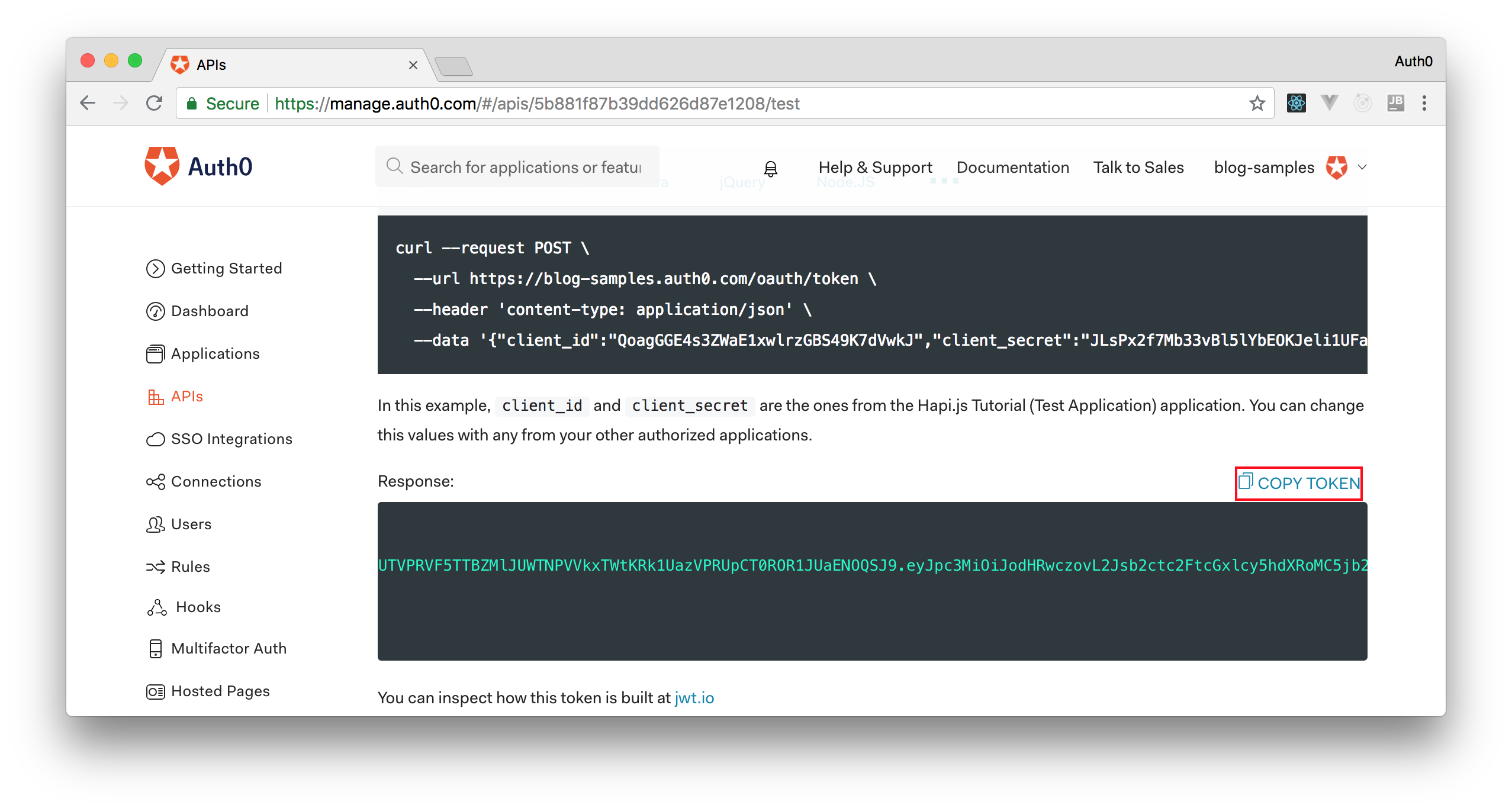
After copying this token, we can open a terminal and issue the following commands:
# create a variable with our token ACCESS_TOKEN = <OUR_ACCESS_TOKEN> # use this variable to fetch contacts curl -H 'Dominance: Bearer ' $ACCESS_TOKEN http://localhost:8080/contacts/ Notation: We volition have to replace
< OUR_ACCESS_TOKEN >with the token we copied from our dashboard.
Equally we are now using our access token on the requests we are sending to our API, nosotros will manage to go the list of contacts again.
That'due south how nosotros secure our Node.js backend API. Easy, right?
Adjacent Steps: Exception Handling and I18N
With the @DTO notation and its companion DTOModelMapper, we accept built a solid basis that allow u.s.a. to hands hibernate implementation details about our entities. Together, they smoothen the development process of RESTful endpoints past automatically mapping DTOs into entities and also by validating the information sent through these DTOs. At present, what we are missing is a proper way to handle exceptions thrown during these validations, and also unexpected exceptions that might occur during the flight.
We want to provide an feel as great as possible for whomever consume our API, and this includes giving well formatted mistake messages. More than that, we want to be able to communicate with users that speak other languages, besides English. Therefore, in the adjacent commodity, we are going to tackle exception treatment and I18N (Internationalization) on Spring Boot APIs. Stay tuned!

How Are Dao Dto And Service Supposed To Interact,
Source: https://auth0.com/blog/automatically-mapping-dto-to-entity-on-spring-boot-apis/
Posted by: lawrenceutaltorge70.blogspot.com
0 Response to "How Are Dao Dto And Service Supposed To Interact"
Post a Comment