

What Are Two Major Global Events That Happened During George F Kennan Services
- With some two.6 billion people around the world in some kind of lockdown, we are conducting arguably the largest psychological experiment always;
- This volition consequence in a secondary epidemic of burnouts and stress-related absenteeism in the latter one-half of 2020;
- Taking action at present tin mitigate the toxic effects of COVID-19 lockdowns.
In the mid-1990s, France was i of the first countries in the world to adopt a revolutionary approach for the aftermath of terrorist attacks and disasters. In addition to a medical field hospital or triage postal service, the French crisis response includes setting up a psychological field unit of measurement, a Cellule d'Urgence Médico-Psychologique or CUMPS.
In that 2nd triage mail, victims and witnesses who were not physically harmed receive psychological assist and are checked for signs of needing further mail service-traumatic treatment. In those situations, the Globe Wellness Organization recommends protocols like R-TEP (Contempo Traumatic Episode Protocol) and Grand-TEP (Grouping Traumatic Episode Protocol).
Since France led the way more than than 20 years agone, international playbooks for disaster response increasingly call for this two-tent approach: one for the wounded and one to treat the invisible, psychological wounds of trauma.
In treating the COVID-nineteen pandemic, the world is scrambling to build enough tents to treat those infected with a deadly, highly contagious virus. In New York, we see literal field hospitals in the middle of Central Park.
But we're not setting up the 2nd tent for psychological help and we will pay the cost within iii to six months afterward the terminate of this unprecedented lockdown, at a time when nosotros will need all able bodies to help the earth economic system recover.

The mental cost of quarantine and lockdown
Currently, an estimated 2.6 billion people – one-third of the world'southward population – is living under some kind of lockdown or quarantine. This is arguably the largest psychological experiment ever conducted.
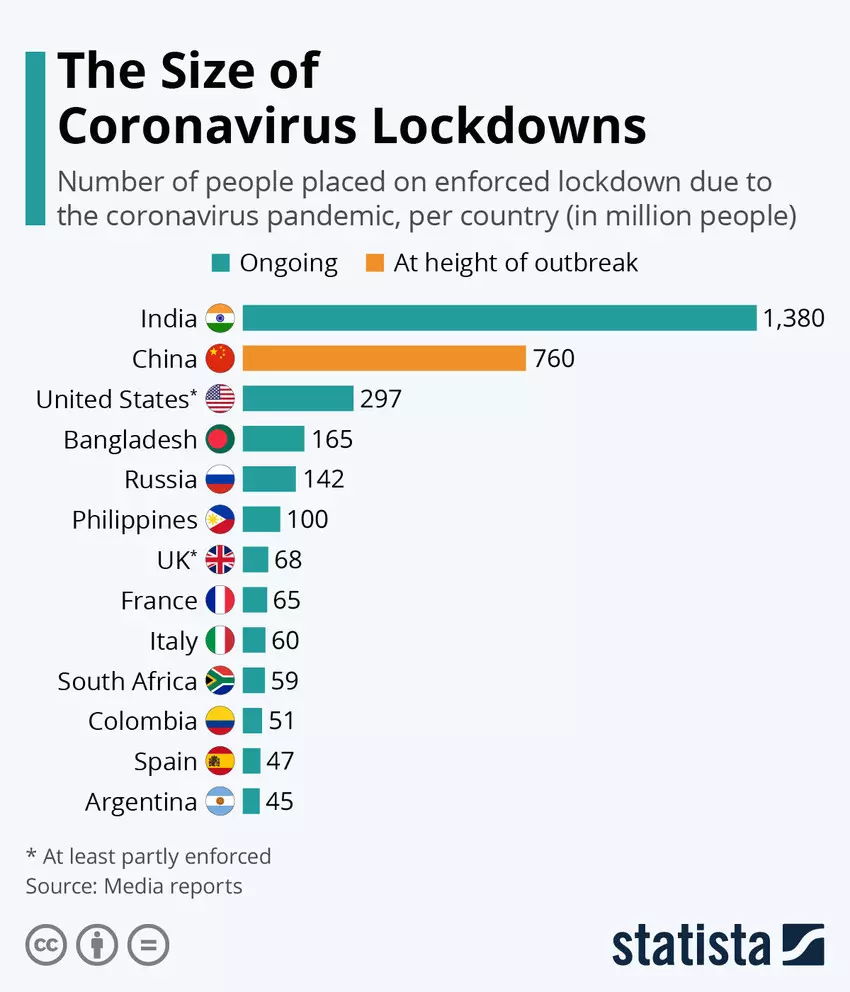
Estimated size of lockdowns around the world
Image: Statista
Unfortunately, we already have a skilful idea of its results. In belatedly February 2020, correct before European countries mandated various forms of lockdowns, The Lancet published a review of 24 studies documenting the psychological impact of quarantine (the "restriction of movement of people who accept potentially been exposed to a contagious disease"). The findings offering a glimpse of what is brewing in hundreds of millions of households around the world.
In short, and maybe unsurprisingly, people who are quarantined are very likely to develop a broad range of symptoms of psychological stress and disorder, including low mood, insomnia, stress, anxiety, acrimony, irritability, emotional burnout, depression and post-traumatic stress symptoms. Low mood and irritability specifically stand out as beingness very common, the report notes.
In People's republic of china, these expected mental wellness effects are already being reported in the first research papers nigh the lockdown.
In cases where parents were quarantined with children, the mental wellness toll became even steeper. In one written report, no less than 28% of quarantined parents warranted a diagnosis of "trauma-related mental health disorder".
Among quarantined hospital staff, most 10% reported "high depressive symptoms" up to three years afterward being quarantined. Another study reporting on the long-term furnishings of SARS quarantine among healthcare workers constitute a long-term risk for booze corruption, self-medication and long-lasting "abstention" behaviour. This means that years after being quarantined, some hospital workers notwithstanding avoid existence in shut contact with patients by just not showing upwardly for work.
Reasons for stress abound in lockdown: there is risk of infection, fear of becoming sick or of losing loved ones, also as the prospect of financial hardship. All these, and many more, are present in this current pandemic.
The second epidemic and setting up the second tent online
We tin already see a sharp increment in absenteeism in countries in lockdown. People are agape to grab COVID-19 on the work floor and avert work. We will see a 2d moving ridge of this in 3 to six months. Just when we demand all able bodies to repair the economy, we can expect a sharp spike in absenteeism and burnout.
We know this from many examples, ranging from absenteeism in armed services units after deployment in risk areas, companies that were close to Footing Nix in 9/11 and medical professionals in regions with outbreaks of Ebola, SARS and MERS.
Right before the lockdown, nosotros conducted a benchmark survey among a representative sample of the Belgian population. In that survey, nosotros saw that 32% of the population could exist classified every bit highly resilient ("green"). But 15% of the population indicated toxic levels of stress ("red").
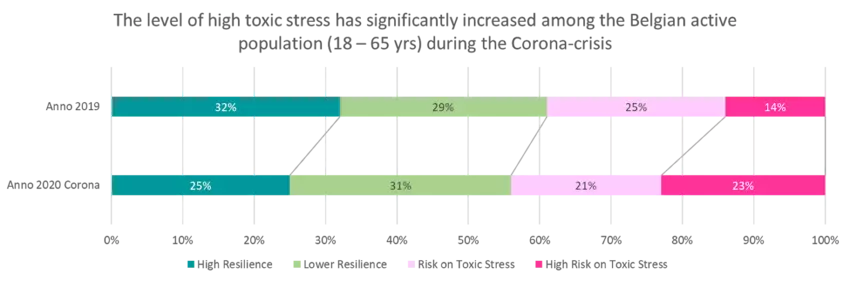
How stress nether lockdown is affecting Belgians
In our most recent survey after two weeks of lockdown, the green portion has shrunk to 25% of the population. The "red" part of the population has increased by ten percentage points to fully 25% of the population.
These are the people at high risk for long-term absenteeism from work due to illness and exhaustion. Even if they stay at work, research from Eurofound reports a loss of productivity of 35% for these workers.
In general, nosotros know at-risk groups for long-term mental wellness bug volition be the healthcare workers who are on the frontline, immature people under 30 and children, the elderly and those in precarious situations, for instance, attributable to mental illness, disability and poverty.
All this should surprise no one; insights on the long-term impairment of disasters have been accepted in the field of trauma psychology for decades.
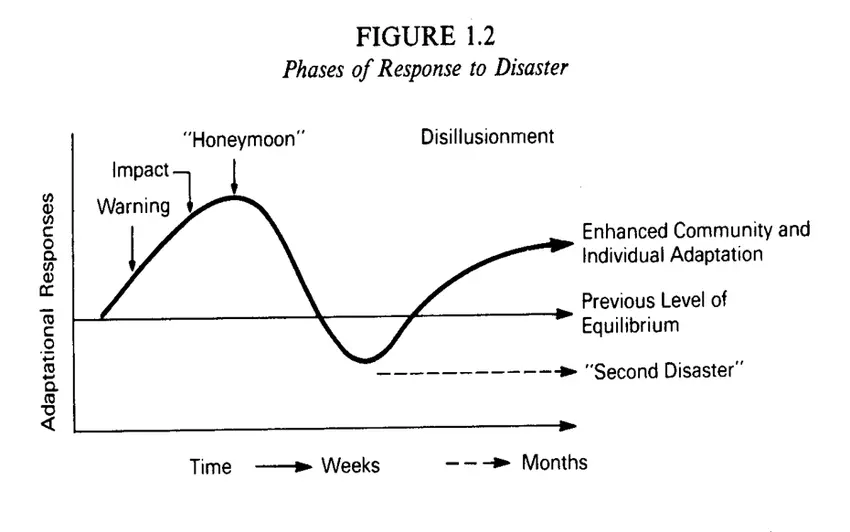
The phases of disaster response
Image: When disaster strikes, Beverly Raphael, 1986
But while the insights are not new, the sheer scale of these lockdowns is. This time, ground nothing is not a quarantined village or town or region; a 3rd of the global population is dealing with these intense stressors. We demand to human activity now to mitigate the toxic effects of this lockdown.
What is the World Economic Forum doing about the coronavirus outbreak?
Responding to the COVID-19 pandemic requires global cooperation among governments, international organizations and the business customs, which is at the centre of the World Economic Forum's mission equally the International Organization for Public-Private Cooperation.
Since its launch on xi March, the Forum's COVID Action Platform has brought together 1,667 stakeholders from 1,106 businesses and organizations to mitigate the risk and affect of the unprecedented global health emergency that is COVID-19.
The platform is created with the support of the World Wellness Organization and is open up to all businesses and industry groups, besides as other stakeholders, aiming to integrate and inform joint action.
As an organization, the Forum has a track tape of supporting efforts to contain epidemics. In 2017, at our Annual Meeting, the Coalition for Epidemic Preparedness Innovations (CEPI) was launched – bringing together experts from government, business, health, academia and civil social club to accelerate the evolution of vaccines. CEPI is currently supporting the race to develop a vaccine against this strand of the coronavirus.
What governments and NGOs tin and should exercise today
In that location is broad consensus among academics near the psychological care following disasters and major incidents. Here are a few rules of thumb:
- Make sure self-help interventions are in identify that can accost the needs of big affected populations;
- Brainwash people most the expected psychological impact and reactions to trauma if they are interested in receiving information technology. Make sure people sympathise that a psychological reaction is normal;
- Launch a specific website to address psychosocial bug;
- Make sure that people with acute problems can find the help that they demand
In Kingdom of belgium, we recently launched Anybody OK, an online tool that tries to offer assist to the affected population. Using existing protocols and interventions, nosotros launched our digital self-assistance tool in as fiddling equally two weeks.
When it comes to offer psychological support to their populations, most countries are late to react, as they were to the novel coronavirus. Better late than never.
This article is part of the COVID Activeness Platform for Media, a coalition of over 20 media from around the world. The Platform aims to create meaningful and constructive content on the COVID pandemic, and syndicates it through its media partners. Interested? Sign upward here

Source: https://www.weforum.org/agenda/2020/04/this-is-the-psychological-side-of-the-covid-19-pandemic-that-were-ignoring/
Posted by: lawrenceutaltorge70.blogspot.com
0 Response to "What Are Two Major Global Events That Happened During George F Kennan Services"
Post a Comment